

Carbon nanotubes showcase high tensile strength and conductivity, as well as electrical resistivity and good charge carrying capacity. IDTechEx's report "Carbon Nanotubes 2025-2035: Market, Technology & Players" covers the main manufacturing methods and applications for this technology, as well as forecasts for their development over the next ten years.
Carbon nanotubes (CNT) exist within the advanced carbon family, which consists of many types and dimensions, from 3D carbon black and natural graphite through to 2D nanocarbons and 0D Buckminster fullerene. Nanotubes are therefore both competing, and acting as a complementary material, alongside many other advanced carbon types, as they each offer various benefits, with the scale of advanced carbons also able to be expanded further into its different segments.
The CNT market at a glance
The high-performing characteristics of CNTs make them a highly sought-after material, particularly due to their tensile strength, conductivity, and strong ability to carry charge when compared to alternatives such as copper.
The global capacity of multi-wall CNTs has grown with a compound annual growth rate of 22% over the last two decades, according to IDTechEx, highlighting a promising future for the technology with further expansions. CNTs are now described as being in a period of rapid growth with market leaders beginning to emerge, and the market predicted to reach over US$1.25 billion by 2035, growing at a CAGR of 8.98%.
Within the current CNT market there are some difficulties translating this technology to a larger scale, as in most cases CNTs will need to be incorporated into a composite material which will increase costs. There are also additional expenses involved as materials become increasingly refined - largely dependent on the specific structure of the hexagonal lattice. IDTechEx reports that the optimization of CNTs, taking the above factors into account, can prove somewhat difficult to balance.
Manufacturing methods for CNTs
Laser ablation is one of the earliest methods for manufacturing carbon nanotubes, though can have high energy costs and result in low yields, whilst also being difficult to transfer to a larger scale. Newer methods are explored in depth in IDTechEx's report, including chemical vapour deposition (CVD) - now one of the most developed methods for producing CNTs, of which high pressure carbon monoxide (HiPCO), CoMoCat, eDIPS, and plasma enhanced CVD, are all subsections. Multiple players operating within the industry are also explored within the report, both established and startups.
CNTs for Li-ion batteries and other applications
Cathodes for Li-ion batteries, fuel lines, automotive bumpers, sporting goods, and ESD packaging are the best applications for multi-wall CNTs listed as the closest to maturity in IDTechEx's report. Still within early commercial stages are applications better suited to single-wall CNTs, such as gas sensor and memory technologies.
IDTechEx outlines some of the more promising applications outside of Li-ion batteries going forward as thermal interface materials, conductive composites, reinforced composites, sensors, tires, and concrete and asphalt. Developments across these sectors could see CNTs bringing increased quality and performance.
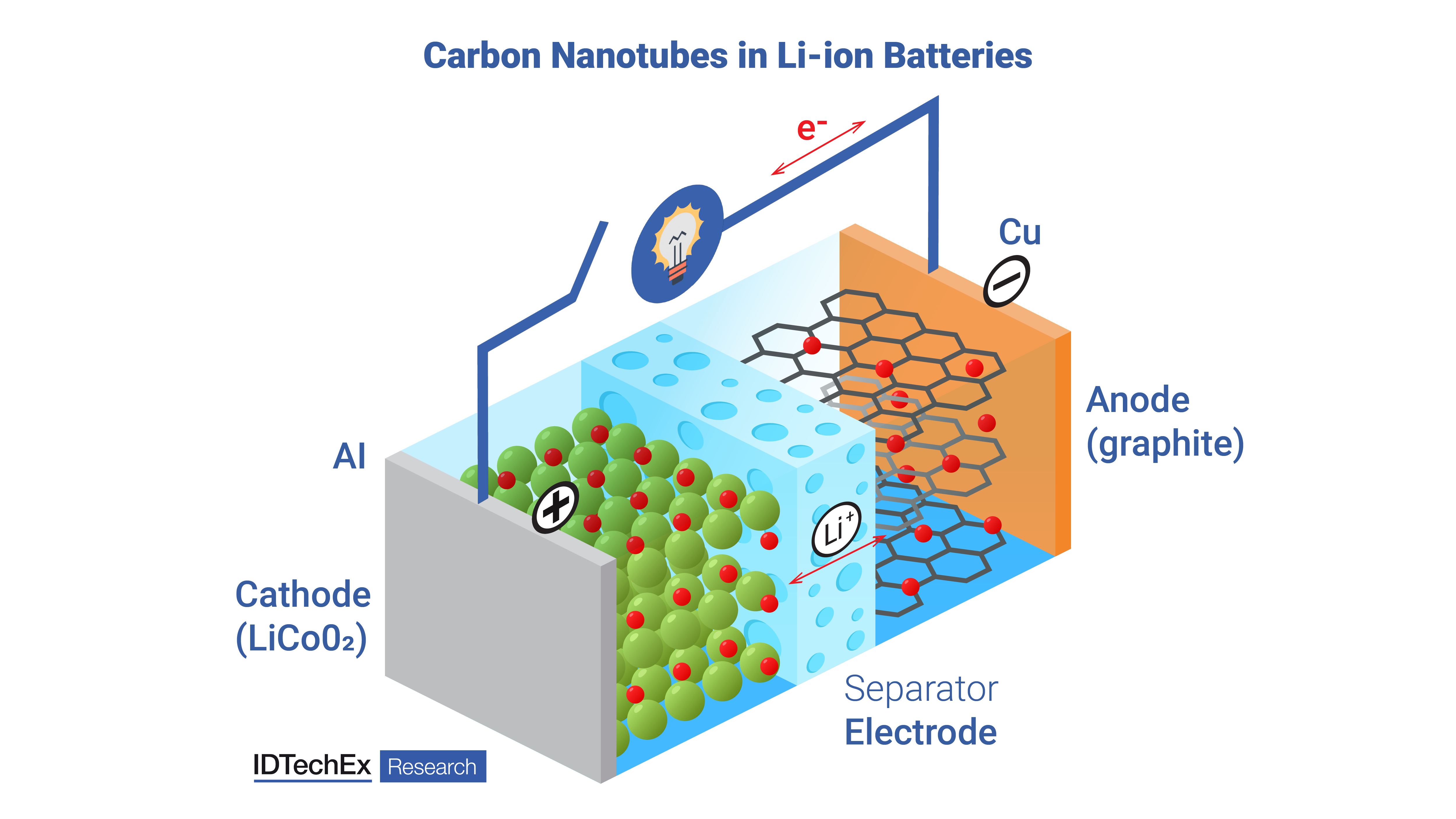
Source: IDTechEx.
Li-ion batteries can benefit from CNTs in both the anode and cathode side of the battery, with advantages such as higher performance at greater C-rates, an increased number of cycles, improved energy density through thicker electrodes, and improved temperature performance. The electrification of the transport sector will be a large driver for Li-ion battery improvements and developments.
Used in conjunction with graphite anodes, CNTs can enhance conductivity and cycle life within a battery, while alongside conductive additives such as carbon black, CNTs can provide better conductive pathways. However, the cost of CNTs and the not-yet-mature supply chain will provide some barriers to uptake within this sector. IDTechEx's report, "Additives for Li-ion Batteries & PFAS-Free Batteries 2026-2036: Technologies, Players, Forecasts" explores the benefits and disadvantages of using CNTs within Li-ion batteries in greater detail.
For more information on the CNT market and the main applications for this emerging technology, visit IDTechEx's report, "Carbon Nanotubes 2025-2035: Market, Technology & Players", and the wider portfolio of Advanced Materials & Critical Minerals Research Reports and Subscriptions.
