

As data centers struggle to handle spiking AI power profiles, supercapacitors are seeing increasing interest for applications in peak shaving and voltage stabilization. However, one of the main questions remaining is where supercapacitors can most effectively be deployed within the data center. This article explores the evolving optimization of supercapacitor data center deployments.
Supercapacitors are well positioned to see deployment in data centers, in order to solve the challenge of protecting data center equipment from rapid power demand surges and voltage drops caused by AI training and prompting. In total, the market for supercapacitors in data centers is expected to reach over US$950 million by 2037 according to IDTechEx's recent report "Supercapacitors for Data Centers 2027-2037: Technologies, Applications, Players and Forecasts." However, several questions remain for supercapacitor deployers and data center operators: where and how exactly should supercapacitors be effectively deployed?
AI data usage patterns - voltage sags, peak shaving and critical load requirements
Hyperscale data centers are seeing significant construction, driven primarily by deployment of AI across a number of industries and services. AI data centers have distinct power demand profiles compared to conventional data centers, due to large transient loads and short-term peaks in power demand. These spikes can be challenging for conventional power architecture to handle. Extreme power demand spikes lead to voltage sags, which in turn can lead to temporary shutting down of servers, equipment failures and grid-wide instability. Solving these issues can help to make AI data centers both more profitable and more palatable for neighbouring authorities and locations that might otherwise oppose development.
Power architecture and backup power systems must therefore be adapted to handle AI power profiles. This requires rapid charging/discharging times (as spikes can be at ms-scale), durability over many charge-discharge cycles, high power density (to reduce footprint for large critical loads) and easy integration into existing power architectures (especially for retrofitting of data centers). Supercapacitors are well positioned for this use-case, as is explored in IDTechEx's recent report.
Data center architecture
Data center designs vary depending on the data center type, location and power supply. However, several features of data center power architectures are consistent. Computations are performed by servers within a rack, which also contains switches, routers, storage and rack-level backup power, e.g. battery backup units (BBUs). Multiple racks are placed together to form an aisle, at the end of which is the power distribution unit (PDU), which routes power to the racks from the facility's centralized power room and includes buffering devices to protect equipment from power surges. The facility's centralized power room will contain both power architecture connecting the facility to the grid, or routing electricity from the grid connection point to the aisles, as well as uninterruptible power supply (UPS), in the form of battery storage units, which will be turned on automatically in the event of a blackout, to bridge the gap between grid outage and diesel generator activation. Supercapacitors may be deployed at rack-, aisle- and UPS room-level, offering different advantages and disadvantages depending on placement.
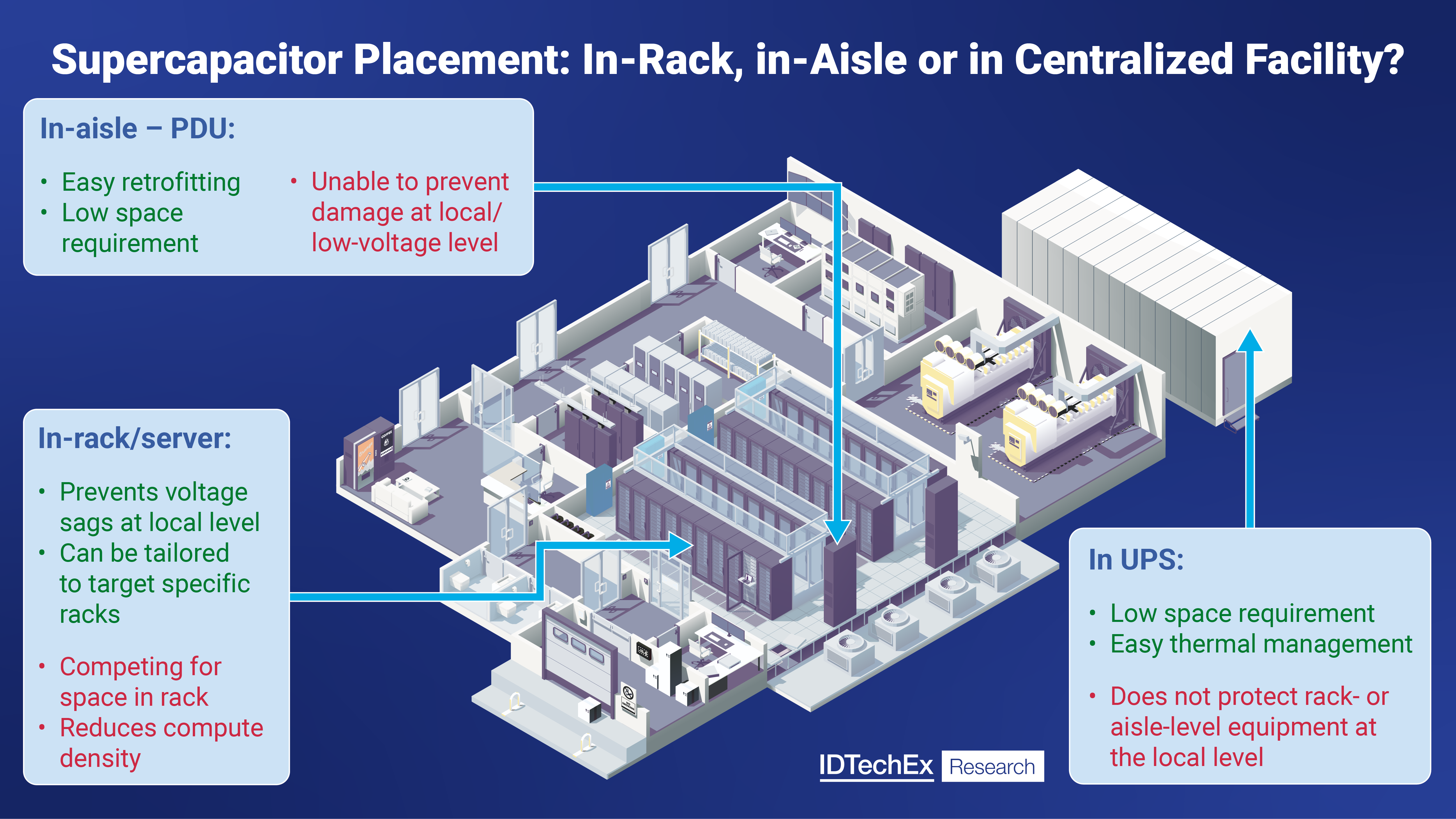
Supercapacitor placement: in-rack, in-aisle or in centralized facility? Source: IDTechEx
Supercapacitor placement: in-rack, in-aisle or in UPS facility
In-rack supercapacitor placements, e.g. within BBUs, are likely to be optimal for new-build AI data centers. This is because in-rack deployment allows for voltage stabilization of low-voltage equipment within the rack/server, which might not otherwise be sufficiently protected from power demand surges at the rack-level. In addition, by deploying at the rack-level, supercapacitor deployments can be made more specific, thereby potentially reducing the overall power demand. For example, in a data center in which not all racks will be utilized for AI, or in which training/prompting is split from standard computation, supercapacitor deployments at rack-level may be limited to appropriate racks. However, aisle-level and UPS room-level deployments are likely to be easier in terms of retrofitting, as well as allowing for higher compute density within the rack. IDTechEx predicts that this will lead to aisle-level and UPS room-level deployments being more popular in the short term, especially in co-location data centers.
UPS room-level deployments offer an additional advantage compared to rack-level deployments, in that a rack-level deployment will not protect high-voltage equipment and power architecture at the facility level, for example cooling systems. As a result, IDTechEx predicts that by 2037, rack-level and UPS room-level deployments will be the most popular for supercapacitors in data centers. For a more detailed analysis of supercapacitor placement, as well as application and use-case analysis, see the recent report by IDTechEx: "Supercapacitors for Data Centers 2027-2037: Technologies, Applications, Players and Forecasts".
For more information on this report, including downloadable sample pages, please visit www.IDTechEx.com/SupercapDC, or for the full portfolio of related research available from IDTechEx, see www.IDTechEx.com.
